Common Adversaries use simplified attributes to speed up play and ease coming up with Adversaries on the fly.
Name: Name can make even common adversaries memorable.
Prowess: Prowess is a general indication of an Adversarys ability. Prowess modifies bonuses to Tests, hit-points and Gifts.
Prowess rates difficulty of the adversary in relation to player characters, it does not model exact physical or mental capabilities. Giants ability to pull trees out of the ground and hurl adventurers across caves is based on them being a creature of great height, weight and might in relation to the world. This does not mean that giants Prowess is extremely high. It means that when a giant manages to catch an unwary adventurer the consequences will be dire.
Prowess is rated from 1 to 10. Adversaries with Prowess of 0 or 1 are sick or weakened in some way. Prowess 2 and 3 are the average for mortals, 4 and 5 represent talent, training and experience. Prowess beyond 5 means heroic ability. Prowess of 8 or higher is legendary.
Skills: Skills are the clear representation of adversarys abilities. Rated Strong and Capable.
• Strong: Add full Prowess as bonus
• Capable: Add half Prowess as bonus
If Skills do not fit a Test adversary gains no bonuses.
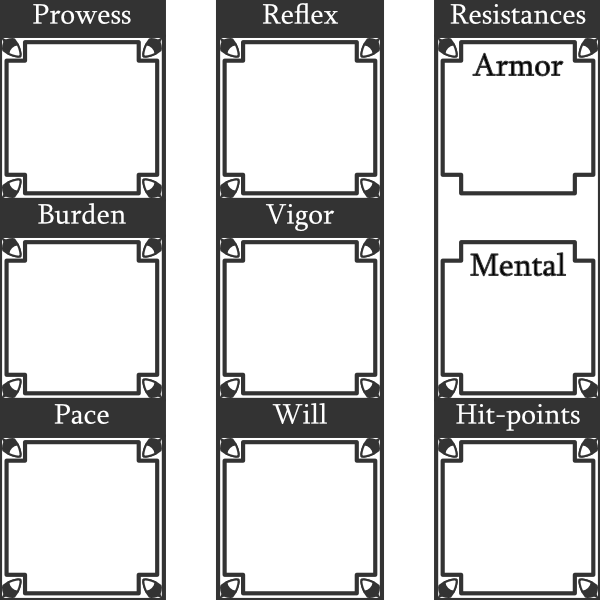
Defenses: Adversarys Defenses work like Skills. Strong Defenses add full Prowess as bonus and Capable Defenses add half Prowess as bonus.
Burden: Adversaries do not Exhaust to gain bonuses to Tests. However they can Exhaust to use Gifts.
Burden Treshold is adversarys Prowess and they cannot exceed it.
Gifts: Special abilities adversary possesses.
Significant pieces of equipment are represented by Gifts that give the adversary additional benefits like Armor Resistance and attack options.
Pace: Adversarys movement.
Harm: Adversarys natural attacks. Punches, bites and thrashing around deals Harm damage.
Example adversaries
Example adversaries and detailed statistics can be found in the pdf-rulebook see Downloads.
Adversary size
Tiny: Mice, spiders and vermin. Tiny beings do not deal physical damage, but they can spread poison and disease. Tiny beings are Hidden unless specifically searched for or part of a swarm.
Hit-points base: Prowess.
Small: Cats and falcons. Small beings have Advantage on stealth.
Hit-points base: 2 + Prowess.
Medium: Humans, dogs and eagles. Player characters are Medium sized.
Hit-points base: 5 + Prowess.
Large: Horses, oxen and trolls. Large beings deal +1 die of physical damage, have +1 Wound.
Hit-points base: 10 + Prowess.
Huge: Mammoths and giants. Huge beings roll +2 dice of physical damage. Huge beings have +2 Wounds and Disadvantage on stealth.
Hit-points base: 20 + Prowess.
Grouped Adversaries
Group
Adversaries can work as a group by taking a simultaneous action or Response.
• Every adversary in the group uses an Action or Response
• Adversaries bonus to Test is increased by + 1 for each member of the group
• Group size is limited to number of adversaries able to reach the target
Swarm
Horde of ravenous dead, skittering sea of scarabs and a glittering shield wall of hoplites are swarm adversaries.
• Swarms cover an area, usually Reach or Close across. Swarm can affect all targets within its area or within Reach of its area as a single Action
• Non-area attacks deal at most 1 + 1 for each Degree damage to a swarm
• Swarm is treated as a being of a greater size category for Hit- points, damage dice and Wounds. If swarm is especially large increase size by two categories or more
• Swarm of Tiny beings can share a space with a larger being